What’s the difference between Agents, Tools, Workflows, and RPA?
(And why confusing them leads to broken AI systems)
Kamal Shahid
1/20/20262 min read
Over the past year, terms like AI agents, tools, workflows, and RPA have been used almost interchangeably.
They are not the same—and mixing them up is one of the biggest reasons AI projects fail in production.
This post clarifies the difference in practical, real-world terms, especially for voice AI, WhatsApp automation, call centers, and universities.
1. Tools: What an AI can use
A tool is a capability, not intelligence.
Examples:
Fetch student record from an LMS
Create a ticket in a CRM
Check fee status in ERP
Schedule a call
Tools do not decide when or why they are used.
They simply wait to be invoked.
Think of tools as buttons — powerful, but useless without someone pressing them.
2. Workflows: Predefined paths
A workflow is a fixed sequence of steps:
If A happens → do B
If B fails → restart or escalate
Workflows are:
Predictable
Deterministic
Easy to audit
They work well when:
Processes are stable
Inputs are structured
Variations are limited
They fail when:
Conversations go off-script
Users interrupt
Context changes mid-flow
Workflows follow paths. They don’t understand goals.
3. RPA (Robotic Process Automation): UI-level automation
RPA automates human actions on software interfaces:
Clicking buttons
Copying data
Filling forms
Key characteristics:
Operates at UI level
Extremely brittle
Breaks when screens change
No semantic understanding
RPA is excellent for:
Legacy systems
Back-office automation
RPA is not conversational AI.
It cannot reason, plan, or recover.
4. AI Agents: Goal-driven decision makers
This is where the real shift happens.
An AI agent:
Understands intent, not just input
Has a goal (e.g., resolve admission query)
Decides the next best action dynamically
Chooses which tool to use, when, and why
Adapts when something fails
Escalates intelligently with full context
An agent does not follow a single path.
It plans, executes, evaluates, and adjusts.
Agents don’t run steps. They pursue outcomes.
Putting it together (Real Example: University Admissions)
Tools: LMS lookup, fee calculator, calendar scheduling
Workflow: “Ask program → show fee → end call”
RPA: Filling admission form on legacy portal
Agent:
Understands the student’s background
Checks eligibility
Answers questions dynamically
Schedules follow-up
Hands over to a human advisor with full context
Same components.
Very different intelligence.
The biggest mistake teams make
Calling a system an “AI agent” when:
It cannot decide
It cannot recover
It cannot change strategy
It only follows predefined flows
That’s not an agent.
That’s automation with better marketing.
Final takeaway
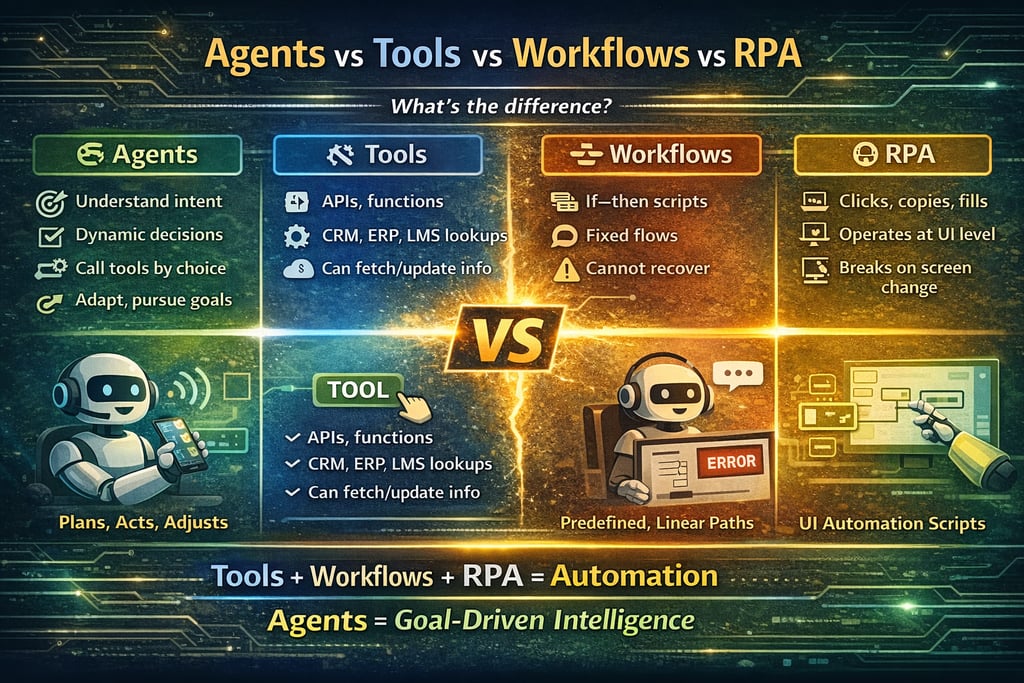
Tools = capabilities
Workflows = fixed paths
RPA = UI automation
Agents = goal-driven intelligence
Modern voice AI and WhatsApp systems don’t replace workflows or tools.
They orchestrate them intelligently.
This distinction is the difference between:
A nice demo
And a system that actually works in production
If you’re building or evaluating AI systems, this mental model will save months of frustration.